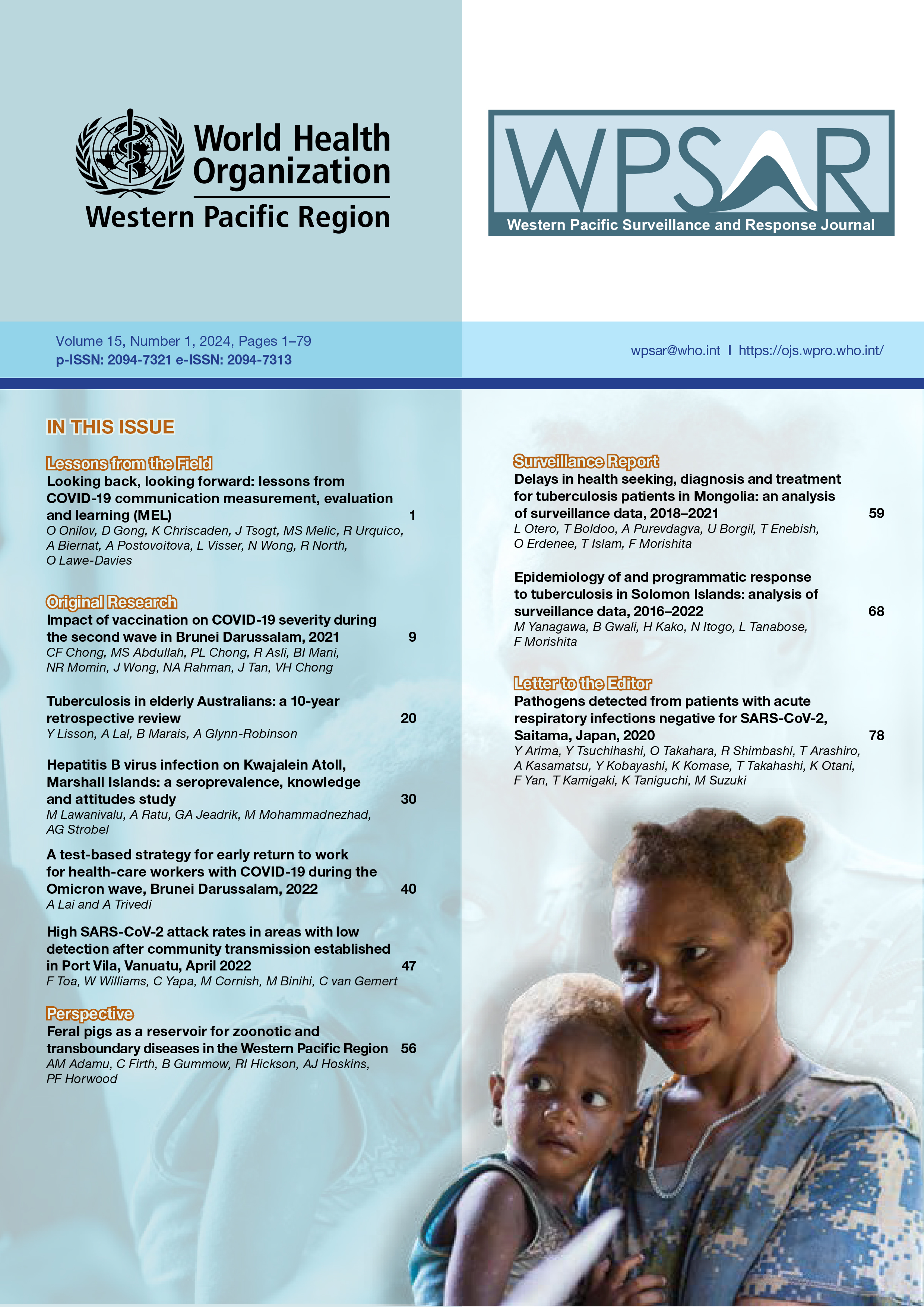
High SARS-CoV-2 attack rates in areas with low detection after community transmission established in Port Vila, Vanuatu, April 2022
DOI:
https://doi.org/10.5365/wpsar.2024.15.1.1078Keywords:
SARS-CoV-2, incidence, COVID-19, cross-sectional studies, disease outbreaks, VanuatuAbstract
Objective: On 4 March 2022, the first community-acquired case of severe acute respiratory syndrome coronavirus 2 (SARS-CoV-2) was reported in Vanuatu, with community transmission occurring subsequently. It was expected that the number of notified SARS-CoV-2 cases would be an underestimate of the true infection rate of this outbreak; however, the magnitude of underreporting was unknown. The purpose of this study was to provide a population-based estimate of SARS-CoV-2 infection shortly after the first reports of community transmission, to understand the level of underdetection and undernotification in Vanuatu and thus to inform ongoing prevention and response activities.
Methods: We conducted a cross-sectional SARS-CoV-2 prevalence study in two geographical administrative areas in Port Vila, Vanuatu in April 2022. All residents in selected areas were eligible. Trained teams conducted demographic and behavioural interviews and collected nasal specimens. Specimens were tested by polymerase chain reaction. The primary outcomes were the rates of SARS-CoV-2 attack (point prevalence) and cumulative attack, underdetection, notification and household secondary attack.
Results: A total of 252 people from 84 households participated. Among 175 people who had a sample collected, 91 were SARS-CoV-2-positive (attack rate 52.0%). Most cases had not been detected before the study (underdetection rate 91.5%). More than half of previously detected cases were notified (notification rate 65.2%).
Discussion: Within the first few weeks of community transmission, more than half of participants in the selected areas had evidence of SARS-CoV-2 infection; however, most infections had been undetected. This study provides important information about the rapid spread of novel infectious diseases in Vanuatu.
Downloads
Downloads
Published
Issue
Section
License
You are free to:
- Share — copy and redistribute the material in any medium or format for any purpose, even commercially.
- Adapt — remix, transform, and build upon the material for any purpose, even commercially.
- The licensor cannot revoke these freedoms as long as you follow the license terms.
Under the following terms:
- Attribution — You must give appropriate credit, provide a link to the license, and indicate if changes were made. You may do so in any reasonable manner, but not in any way that suggests the licensor endorses you or your use.
- No additional restrictions — You may not apply legal terms or technological measures that legally restrict others from doing anything the license permits.
Notices:
When the Licensor is an intergovernmental organization, disputes will be resolved by mediation and arbitration unless otherwise agreed.
You do not have to comply with the license for elements of the material in the public domain or where your use is permitted by an applicable exception or limitation.
No warranties are given. The license may not give you all of the permissions necessary for your intended use. For example, other rights such as publicity, privacy, or moral rights may limit how you use the material.