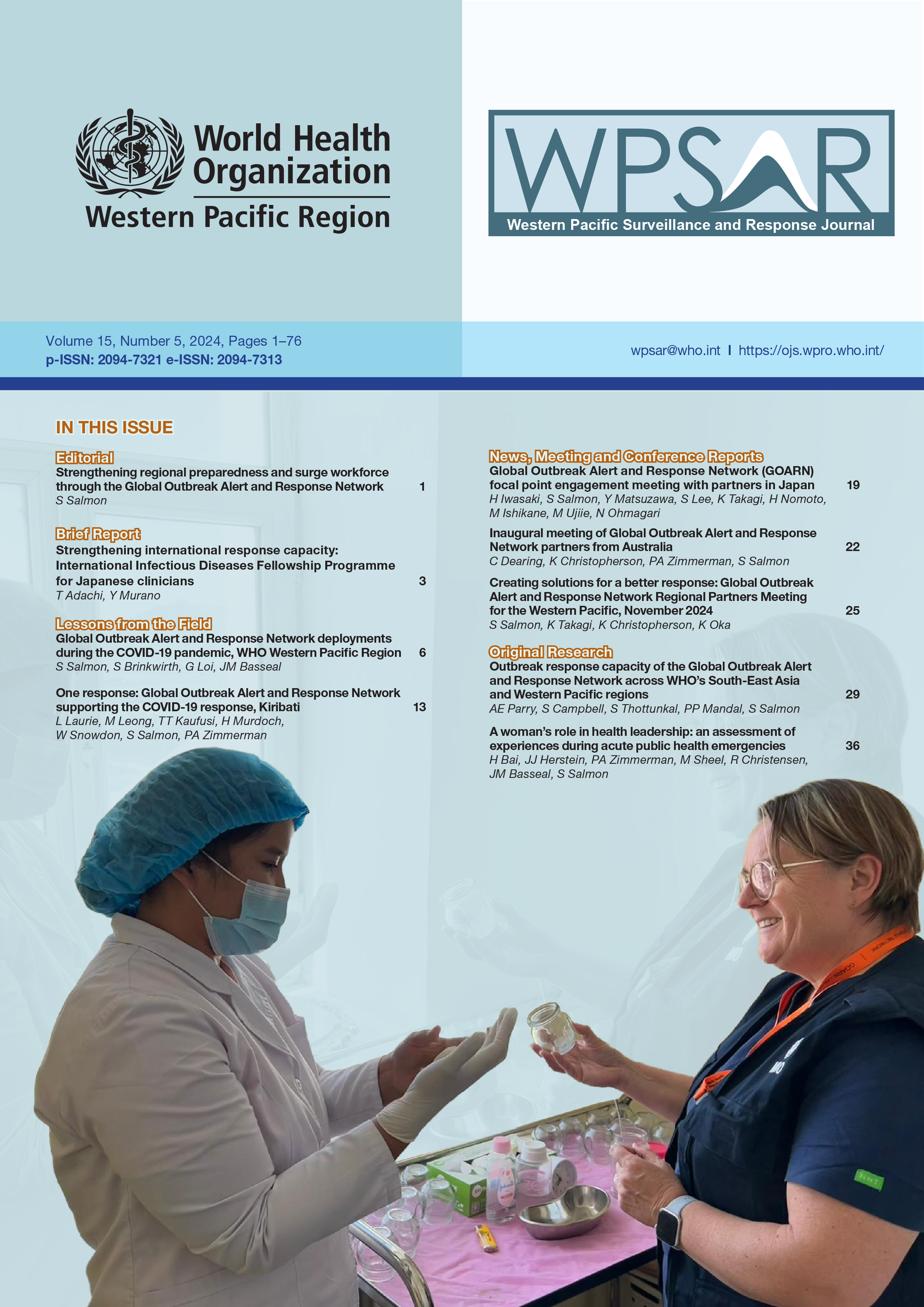
A woman’s role in health leadership: an assessment of experiences during acute public health emergencies
DOI:
https://doi.org/10.5365/wpsar.2024.15.5.1303Keywords:
emergency response, leadership, women, public health, global health, global outbreak alert and response network, western pacificAbstract
Objective: We explored the experiences of women in senior or leadership roles in navigating and leading during acute public health emergencies.
Methods: Women leaders in the World Health Organization Western Pacific Region attending the Global Outbreak Alert and Response Network’s Outbreak Response Leadership Training (11–18 September 2024) were invited to participate in this phenomenological study. Eleven interviews were conducted with training attendees and observational data were gathered. Inductive thematic analysis was conducted to identify key themes.
Results: Four themes associated with women-centric experiences in public health emergency response were identified: disproportionate expectations in the workplace; the use of authoritarian decision-making during planning and implementation; encompassing different perspectives and leadership styles compared to men; and requesting additional opportunities and equitable prospects for career growth. Four themes that reflect non-gender-exclusive challenges experienced during emergency responses were also detailed. Themes observed were related to: barriers to efficiency; consequences of working within this field; and needs and necessities during emergency response.
Discussion: This study highlights both gender-specific and systemic challenges experienced by women leaders in public health emergency responses, revealing how sociocultural norms and operational barriers intersect during times of crisis. We identified opportunities to assist women leaders through the recognition and promotion of different leadership styles, establishing a support network for women, and addressing systemic and organizational barriers that impact women.
Downloads
Downloads
Published
Issue
Section
License
You are free to:
- Share — copy and redistribute the material in any medium or format for any purpose, even commercially.
- Adapt — remix, transform, and build upon the material for any purpose, even commercially.
- The licensor cannot revoke these freedoms as long as you follow the license terms.
Under the following terms:
- Attribution — You must give appropriate credit, provide a link to the license, and indicate if changes were made. You may do so in any reasonable manner, but not in any way that suggests the licensor endorses you or your use.
- No additional restrictions — You may not apply legal terms or technological measures that legally restrict others from doing anything the license permits.
Notices:
When the Licensor is an intergovernmental organization, disputes will be resolved by mediation and arbitration unless otherwise agreed.
You do not have to comply with the license for elements of the material in the public domain or where your use is permitted by an applicable exception or limitation.
No warranties are given. The license may not give you all of the permissions necessary for your intended use. For example, other rights such as publicity, privacy, or moral rights may limit how you use the material.