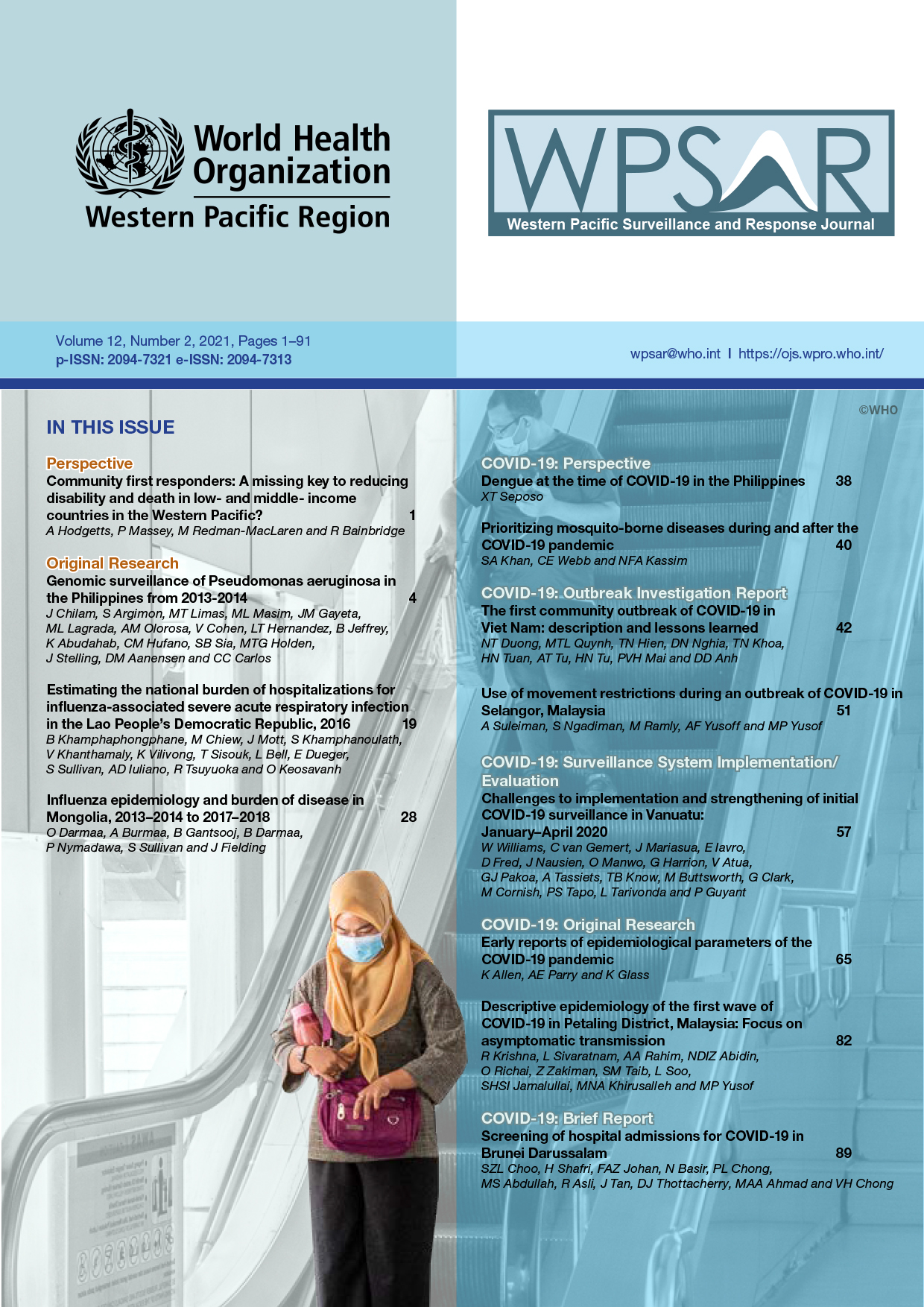
Descriptive epidemiology of the first wave of COVID-19 in Petaling District, Malaysia: Focus on asymptomatic transmission
DOI:
https://doi.org/10.5365/wpsar.2020.11.4.001Abstract
Background: COVID-19 was first detected in Malaysia on 25 January 2020. Multiple clusters were detected in Petaling District, with the first locally transmitted case reported on 8 February. Descriptive analyses of the epidemiology of the COVID-19 outbreak in Petaling are presented, from the first case to the end of the first wave.
Methods: All laboratory-confirmed COVID-19 cases reported to the Petaling District Health Office between 1 February and 26 June 2020 were analysed. Socio-demographic characteristics, symptoms, date of onset, date of exposure, travel history and history of comorbidities were obtained by phone interviews using one of two investigation forms. The descriptive analysis was conducted according to time, place and person.
Results: There were 437 COVID-19 cases, for an incidence rate of 24/100 000 population. Ten (2.3%) deaths and 427 recovered cases were recorded. Of the 437 cases, 35.5% remained asymptomatic and 64.5% were symptomatic. Common symptoms included fever (43.8%), cough (31.6%) and sore throat (16.2%); 67.3% had no comorbidities, 62.5% reported close contact with a confirmed case, and 76.7% were local infections. Transmission occurred in four main groups: religious gatherings (20.4%), corporations (15.1%), health facilities (10.3%) and a wholesale wet market (6.4%). In 31.9% of confirmed cases, an epidemiological link to an asymptomatic case was found.
Conclusion: Transmission of the disease by asymptomatic cases should be emphasized to ensure continuous wearing of face masks, hand hygiene and social distancing. Further research should be conducted to better understand the transmission of SARS-CoV-2 from asymptomatic cases.
Downloads
Downloads
Published
Issue
Section
License
You are free to:
- Share — copy and redistribute the material in any medium or format for any purpose, even commercially.
- Adapt — remix, transform, and build upon the material for any purpose, even commercially.
- The licensor cannot revoke these freedoms as long as you follow the license terms.
Under the following terms:
- Attribution — You must give appropriate credit, provide a link to the license, and indicate if changes were made. You may do so in any reasonable manner, but not in any way that suggests the licensor endorses you or your use.
- No additional restrictions — You may not apply legal terms or technological measures that legally restrict others from doing anything the license permits.
Notices:
When the Licensor is an intergovernmental organization, disputes will be resolved by mediation and arbitration unless otherwise agreed.
You do not have to comply with the license for elements of the material in the public domain or where your use is permitted by an applicable exception or limitation.
No warranties are given. The license may not give you all of the permissions necessary for your intended use. For example, other rights such as publicity, privacy, or moral rights may limit how you use the material.