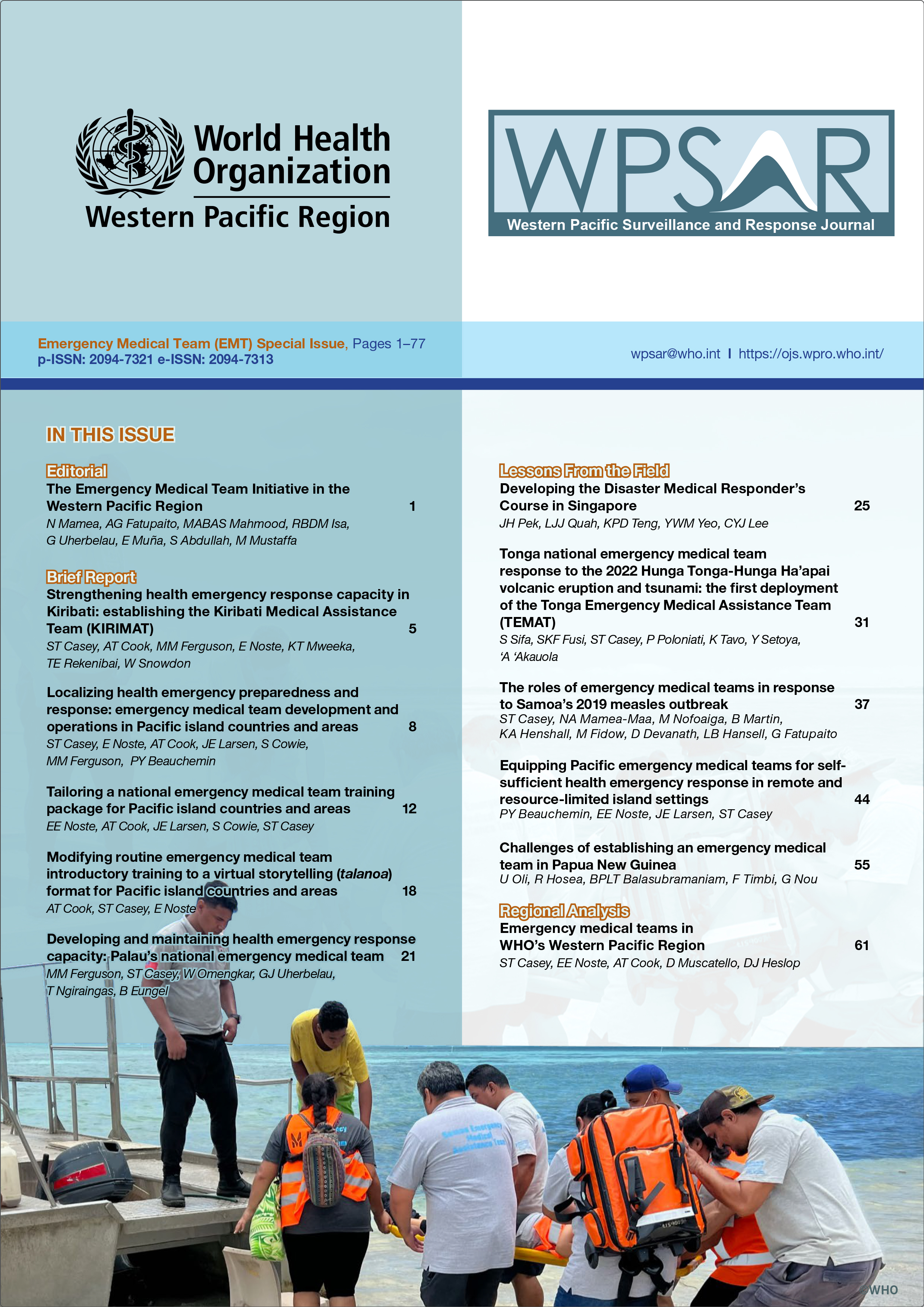
Challenges of establishing an emergency medical team in Papua New Guinea
DOI:
https://doi.org/10.5365/wpsar.2023.14.6.1036Keywords:
COVID-19, pandemics, disasters, rapid response team, developing countries, Papua New Guinea, World Health OrganizationAbstract
Problem: Papua New Guinea (PNG) is situated in the Pacific Ocean and has experienced multiple natural disasters and disease outbreaks. However, PNG lacks the ability to rapidly and systematically deploy trained personnel to provide surge capacity in response to major national disasters. It was therefore decided to establish a national emergency medical team (EMT) in PNG.
Context: PNG’s responses to the 2018 earthquake in the Highlands Region and the coronavirus disease (COVID-19) pandemic required assistance from international EMTs. PNG began developing its own EMT in 2019, coinciding with the development of other Pacific EMTs.
Action: PNG’s EMT project was initiated in 2019 with the creation of a technical working group. By 2021, a focal point had been identified, standard operating procedures had been drafted and training of EMT members had been completed. Pilot deployments of the national EMT members contributed to the COVID-19 response during 2021.
Outcome: Four major challenges were identified during the early phase of PNG’s national EMT development: introducing the concept of EMTs in an EMT-naïve landscape; integrating the national EMT into existing PNG National Department of Health organizational structures; assembling adequate members at short notice to respond to disasters; and securing funding for deployment.
Discussion: Solutions identified for these challenges included strengthening stakeholder involvement through engagement in the development process and participation in technical working groups and consultative group discussions, offering exposure to other Pacific-based EMTs, and creating incentive schemes for EMT members and their place of employment.
Downloads
Downloads
Published
Issue
Section
License
You are free to:
- Share — copy and redistribute the material in any medium or format for any purpose, even commercially.
- Adapt — remix, transform, and build upon the material for any purpose, even commercially.
- The licensor cannot revoke these freedoms as long as you follow the license terms.
Under the following terms:
- Attribution — You must give appropriate credit, provide a link to the license, and indicate if changes were made. You may do so in any reasonable manner, but not in any way that suggests the licensor endorses you or your use.
- No additional restrictions — You may not apply legal terms or technological measures that legally restrict others from doing anything the license permits.
Notices:
When the Licensor is an intergovernmental organization, disputes will be resolved by mediation and arbitration unless otherwise agreed.
You do not have to comply with the license for elements of the material in the public domain or where your use is permitted by an applicable exception or limitation.
No warranties are given. The license may not give you all of the permissions necessary for your intended use. For example, other rights such as publicity, privacy, or moral rights may limit how you use the material.